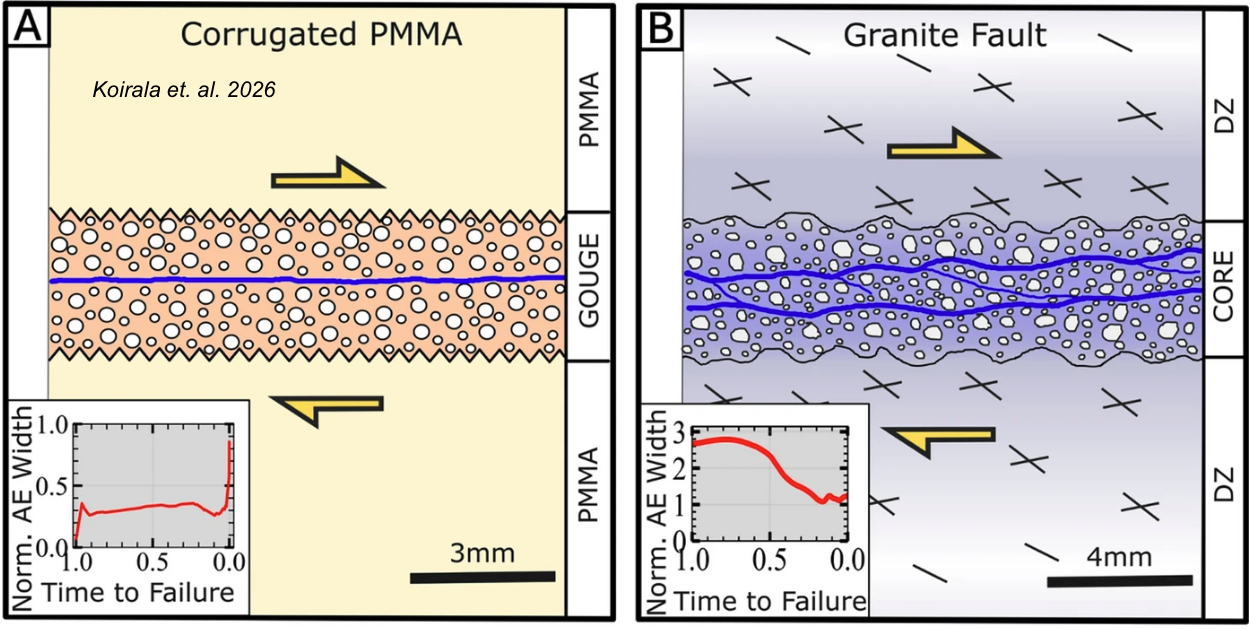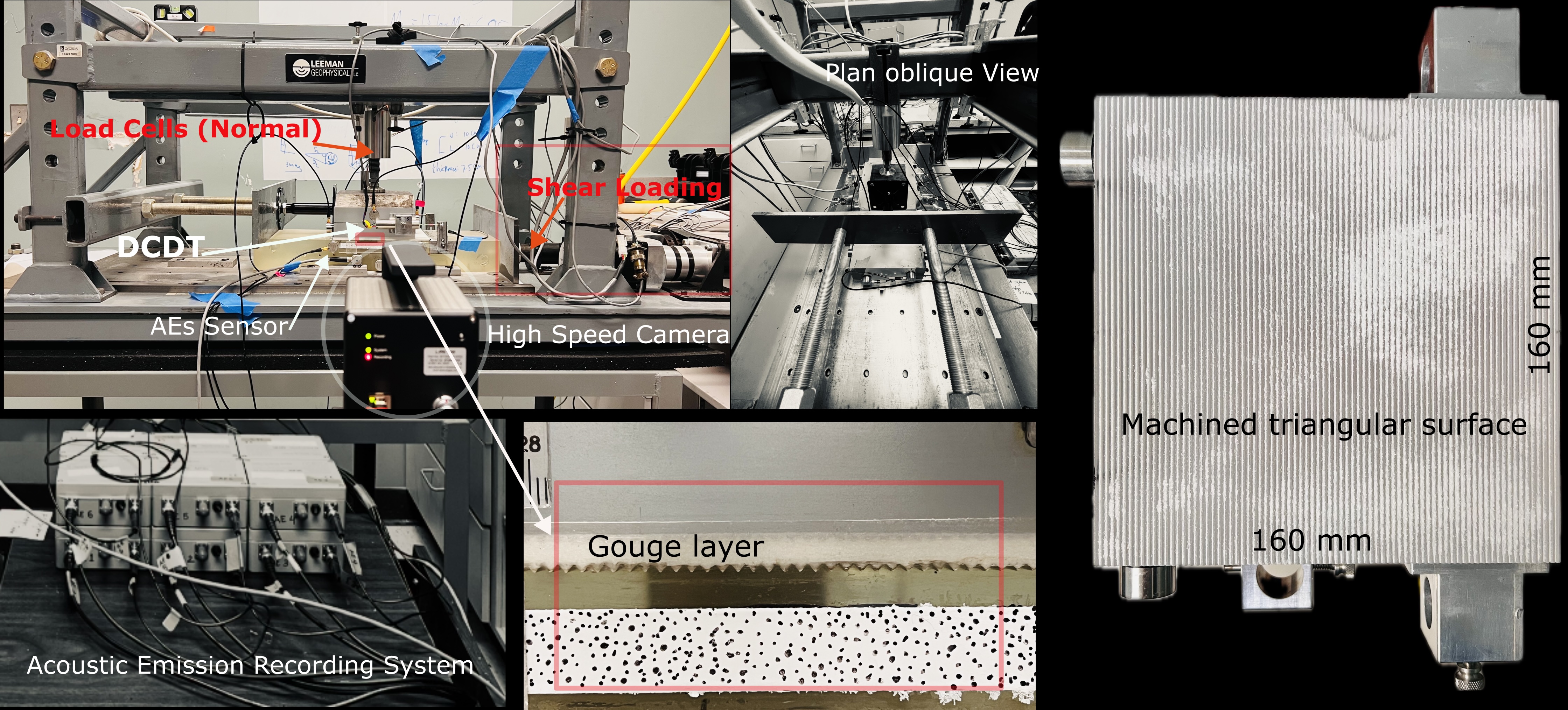
Laboratory direct shear experiments provide a controlled way to investigate how faults prepare for failure. By shearing analog fault materials under measured loading conditions, this project examines how deformation, dilation, stress evolution, and acoustic emissions develop before and during slip. The goal is to connect grain-scale and millimeter-scale processes in the laboratory with broader questions about earthquake nucleation, recurrence, and the conditions that separate stable sliding from unstable failure.
This apparatus supports experiments on fault gouge and engineered fault interfaces where boundary conditions, loading rate, material properties, and sensor geometry can be systematically controlled. Mechanical measurements and acoustic-emission monitoring make it possible to track both the bulk response of the fault and localized deformation within the gouge zone. These observations help test how fault heterogeneity, gouge composition, and evolving damage influence the predictability of laboratory earthquakes.