Does b-Value Increase With Pore-Pressure?: Insights From Laboratory Experiments and Induced Seismicity
Navin Thapa, Georg Dresen, and Thomas H. Goebel
Geophysical Research Letters, 52, e2025GL115740 (2025) · DOI: 10.1029/2025GL115740 ·
Abstract
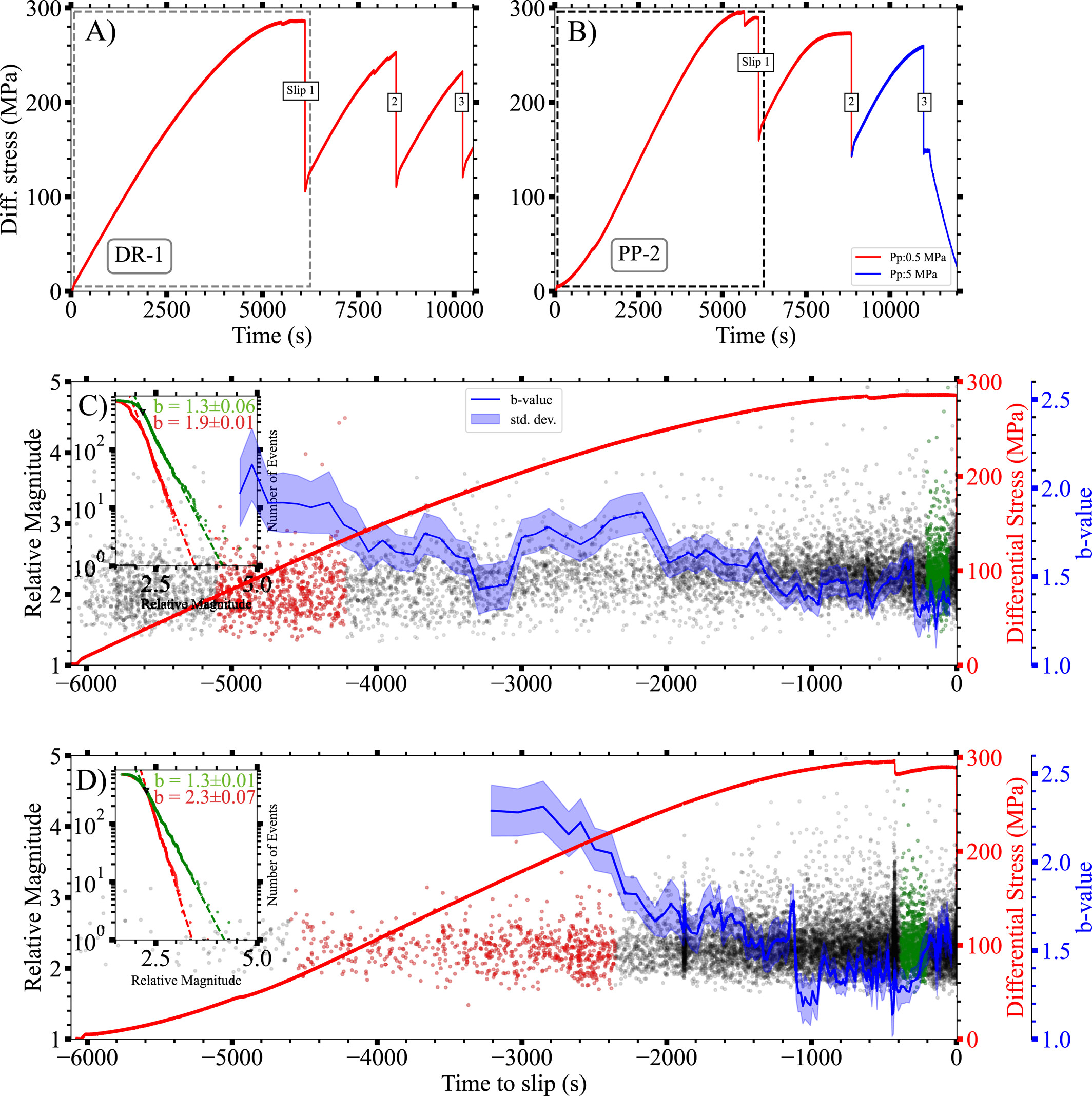
Anthropogenic activities like fluid injection can increase pore-pressure and induce seismicity. Variations in the b-value (slope of the frequency-magnitude distribution) of induced and natural seismic events are thought to reflect the stress state, although recent laboratory results suggest that fault roughness also contributes. In nature, stress, fault roughness, and pore-pressure effects can rarely be disentangled. Here, we investigate these effects and their relative contributions to b-value variation in the laboratory and compare them with hydro-shearing in Enhanced Geothermal System (EGS) reservoirs. Spatial-temporal variations in b-values stem from three distinct factors: (a) Increasing differential stress shows an inverse linear relationship with b-value, with a steeper slope at high pore pressure. (b) Higher pore-pressures, on average, lead to lower b-values. (c) Spatial variations during injection are potentially structurally controlled so that high-damage zones promote higher b-values. We conclude that b-value variations outside the lab require cautious interpretation because of these multiple underlying causes.
Key Findings
- Differential stress governs b-value through an inverse linear relationship. As differential stress increases prior to fault slip, b-value decreases linearly — consistent with earlier experimental studies. Crucially, this slope steepens at elevated pore-pressure, meaning pore-pressure amplifies the stress-sensitivity of the frequency-magnitude distribution.
- Elevated pore-pressure does not unconditionally raise b-value. Contrary to a prevailing assumption in the induced-seismicity literature, higher pore-pressures are, on average, associated with lower b-values in our experiments. The net effect depends on the interplay between pore-pressure, differential stress, and fault geometry.
- Fault-damage zones structurally control spatial b-value variations. During EGS fluid injection, elevated b-values are spatially associated with high-damage fault regions rather than with the injection point itself, indicating that local structural heterogeneity — not pore-pressure alone — drives b-value maxima.
- Multi-factor causation demands cautious b-value interpretation. Because differential stress, pore-pressure, and fault structure each exert separable, independent effects on b-value, single-factor interpretations of b-value changes in natural or induced seismicity sequences are likely insufficient for reliable stress or hazard assessment.
Methods
We conducted triaxial compression and stick-slip experiments on faulted cylindrical Westerly Granite samples across a range of pore-pressures (0.5–35 MPa) at a confining pressure of 150 MPa. Acoustic emissions (AEs) were recorded continuously throughout each experiment using a multi-channel piezoelectric sensor array. AE magnitudes were determined from recorded waveform amplitudes, and b-values were computed using maximum likelihood estimation on rolling time windows within each stick-slip cycle. Laboratory results were compared with seismicity catalogs from hydro-shearing operations at EGS reservoirs, allowing direct evaluation of whether laboratory-scale controls translate to reservoir-scale induced seismicity.
Significance
The b-value is routinely monitored in real-time during subsurface energy operations — including Enhanced Geothermal Systems, wastewater disposal, and carbon storage — as a proxy for stress state and seismic hazard. This study provides the first controlled experimental evidence that pore-pressure, differential stress, and fault structure each contribute separable, measurable effects on b-value. The results imply that current operational protocols relying on b-value thresholds alone may misattribute its cause, and that integrating structural and stress information is necessary for robust induced-seismicity hazard assessment.
Citation
Thapa, N., Dresen, G., & Goebel, T. H. (2025). Does b-value increase with pore-pressure?:
Insights from laboratory experiments and induced seismicity.
Geophysical Research Letters, 52, e2025GL115740.
https://doi.org/10.1029/2025GL115740